
How to choose the right CRM for a small business
Anastasia Chechkova
December 1, 2025
13 min read


Customer Relationship Management (CRM) software helps businesses track all communication with potential, current, and inactive customers.
It also integrates with other tools used to manage a company. In other words, a CRM system provides critical data and insights for your business’s growth.
However, for the CRM to be effective, it has to meet the needs and processes of the business. To generate accurate and reliable insights, the data captured has to be up-to-date.
This is why you need to carry out a CRM audit.
The audit also analyses how employees and management use the CRM software, its impact on the business, and how it can be improved to provide more value.
The data you collect will inform the audit team what to pay attention to and the business processes to be streamlined.
When auditing a CRM, you need to review two aspects:
A CRM usage review is as important as having high-quality data in your CRM.
The usage review tells you how successful your CRM implementation is. For example, many of your employees are using the system and how they are using it. If only 50 percent of your employees log in to the CRM, the data might not be as valuable as when all your employees use the CRM and log their activities.
A CRM audit is a comprehensive undertaking that requires exhaustive analysis of features in the CRM system. As a result, it is difficult to audit the CRM when the business is running.
The best time to conduct your CRM audit is when you are wrapping up the business for the year. This is when various company reports, including financial reports, are prepared. It is usually the end of the business year, but it can vary from business to business.
Determining the best time for a CRM audit can feel like trying to find the perfect moment to start a diet… There’s never a perfect time. But some moments are certainly better than others.
Similar to the seasons of the year, your business follows a cycle. That’s why the CRM audit should be ideally performed when your business has its downtime.
Business downtime is the time when customer interaction is low. This quiet time is a perfect opportunity for a CRM audit.
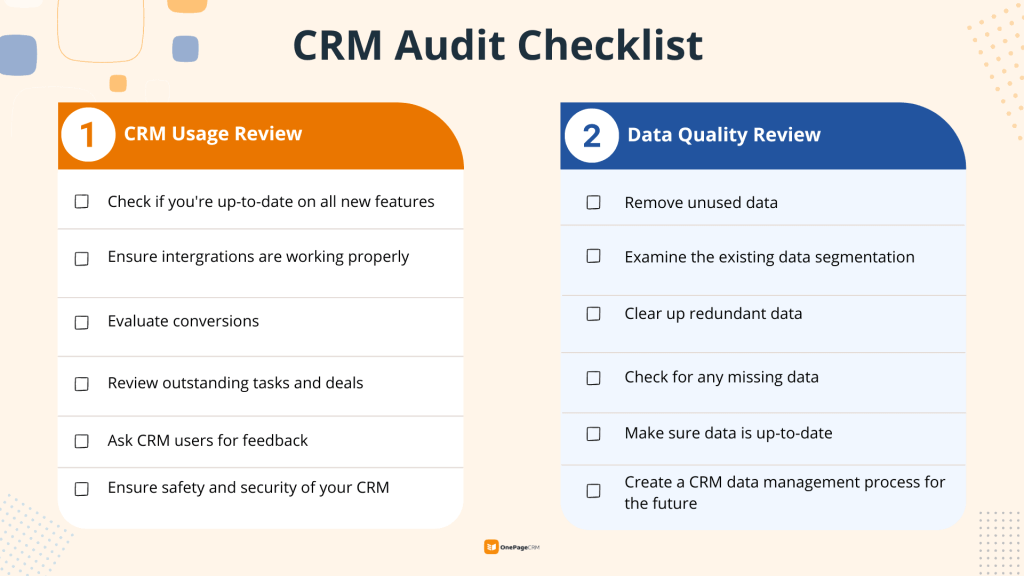
To make it easier for you to perform a CRM audit, we divided it into two major parts: CRM usage review and CRM data quality review.
The checklist below provides a simple overview while this blog post dives deeper into every step of the CRM audit process.
Here’s how to make the most out of this CRM audit checklist:
By reviewing the CRM usage, you can take note of why some employees are not using a CRM, follow up and put mitigation measures in place.
This is especially helpful if you are starting a business or have just introduced CRM into your processes.
The usage review looks at the following:
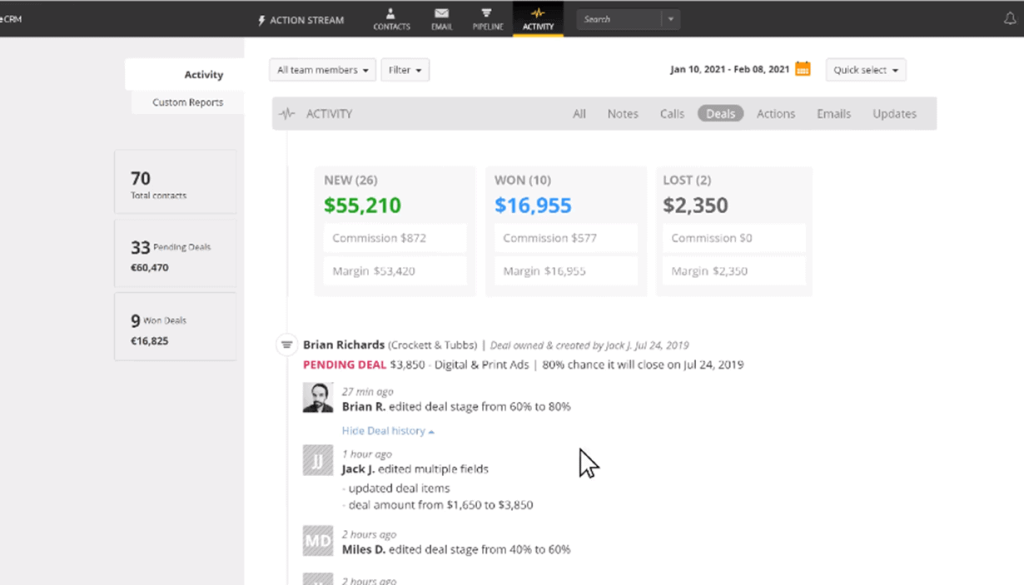
Even if you’re using a simple CRM, ensure that you’re up to date on all feature updates. Even the simplest of CRMs roll out updates regularly to meet and anticipate your business needs. Some CRM updates may be clearing bugs, while others might be monumental, such as overhauling the entire dashboard.
Some updates are very easy to spot while others will require you to do a quick research. Most CRMs update their systems on regular timelines. You can subscribe to their newsletters and announcements to ensure you know when every update is due. It’s also the easiest way to know what your CRM is capable of.
You might not need all new features right now but once you’re aware of them, they’ll be at the back of your mind. Being on top of all updates helps you fully utilize the CRM system and keep your overall business processes compliant with the ever-changing business and privacy laws.
In addition, this helps paint a clear, accurate picture of the effectiveness of the CRM system for your small business.
A CRM system does not work in isolation.
For the system to be effective, it must be integrated with other communication and performance tools. Depending on your needs, you can integrate CRMs with different tools:
CRM integrations help you monitor your entire business from one platform and turn your CRM into a single source of truth. Therefore, when carrying out your CRM audit, you must ensure that all integrations are working smoothly.
Every integrated system was integrated to serve a given purpose. During the CRM audit, you need to assess its effectiveness in serving that purpose and how that aligns with the overall business goals.
To effectively test this, you can design a quality assurance checklist depending on the integration purpose. You should also use heuristics to indicate whether the system is functioning well. For example, if you send a survey of 1000 people and the respondents are more than 1000, there might be a problem.
A CRM is an investment. Therefore, while carrying out the CRM audit, assess the value it provides to your business.
If you have just started using a CRM, you should be able to compare the performance before and after the CRM system. Be mindful of any other changes done in the business so that you objectively analyze a CRM system’s impact on your business.
However, if you’ve had the CRM system for a while, you can track the performance of the business and compare it with the previous year’s performance. The improvement should be indexed and standardized to reflect the contribution of the CRM as an investment.
The value a CRM brings into the business should be compared with the cost of the system. The following formula can be used to calculate the CRM ROI:
(Gain/income from the CRM investment – the cost of the investment) ÷ the cost of the investment = CRM ROI
Most CRM systems can pay back their cost within a short time.
However, if you do not see the expected results, there might be two reasons:
While carrying out the CRM audit, have a look at all incomplete activities, such as outstanding tasks or deals that were never closed.
These incomplete tasks and deals are sales opportunities where you left money on the table. If those activities had been finished, you would have probably made more than you did that year.
Here are a few things you can do:
This will help you improve CRM data quality and gain insight into employees’ performance, your processes, or the nature of your customers. All these insights can be improved upon to grow your business further.
A CRM system is only effective if the users use it properly. While management can force the users to use the system, it is best if the system is seen as a tool that improves the users’ work experience.
Better interaction with the system will see the user performance improve. For example, you can engage them through surveys, interviews, business VoIP phone, or other forms of communication that you use as a company.
You might want to ask questions like:
You should seek to understand what is bothering them in the CRM, what might be improved, and how they wish it were improved. A CRM should enhance employee satisfaction and make their work more fulfilling.
The data can also help you refine your recruitment marketing strategy to ensure you’re employing new staff that can utilize your resources.
A CRM is a data-heavy system. Everything in the CRM and all other integrated systems is logged as a piece of data. Therefore, the safety and security of the CRM system and its data should be a priority.
Here are some tips you can follow to keep your CRM data safe:
After auditing the safety and security of the CRM system, you should move on to analyze the quality of the CRM data.
To fully enjoy the utility of a CRM system, you have to ensure that the CRM data is relevant and of high quality.
Different CRM systems record, categorize and store data in different ways. Therefore, establishing what works for your business and what doesn’t is essential.
Here are a few relevant questions to ask yourself:
These questions will help you evaluate the data you are receiving and the custom fields you need. A good CRM gives you quality data that is accurate and up-to-date. This quality data can be reliably used to make business decisions that are informed and well-considered.
These are the steps you should follow to ensure the quality of your CRM data and do any necessary clean-ups.
A CRM system collects and stores data over a long period of time. Some of the data collected may not be relevant to your business, or it might have expired. Either way, unused data in your system is cluttered and should be cleaned up.
If the data does not inform your insights, there is no point in having it in your system.
To make sense of every data point, you must segment the data appropriately. You can choose how to segment data through filters, tags, or any other classification that works for your business.
During your CRM audit process, assess the effectiveness of your segmentation:
Examining your data segmentation shows whether you are utilizing the CRM system exhaustively. You also get to understand your data loopholes and the unused data in your system.
Redundant data in your system is dangerous because it creates a false illusion. For instance, if some contacts are duplicated, and you send out an email, the same contact will receive communication twice.
Therefore, CRM data needs to be refined and contact duplicates should be merged.
Also, sometimes integrating the CRM with other business systems can lead to these redundancies. You should, therefore, ensure that the integration works the correct way and the two-way sync is enabled.
Data is a great resource, but incomplete data—not so much. Your CRM should provide you with a 360-degree view of your business.
For instance, knowing everything about a potential lead, from their need to what excites them, is a great advantage. But if you are missing their contact details, the information you have is most likely useless.
On the other hand, having a client’s contact information and not knowing at what stage in your sales process they are in is also ineffective.
While carrying out the CRM audit, highlight all the pieces of missing data. This can open doors for more business.
Up-to-date data ensures that you are getting accurate readings from your CRM. For instance, if someone is a new client, the communication with that client differs from those who’ve been with your business for a few years.
Moreover, your clients will change jobs, addresses, and places of residence. If not properly maintained, the personal information in the system can become expired data, hence unusable. For example, you can no longer use their previous phone number and address to conduct business with them.
Therefore, while conducting your CRM audit, ensure that all the data in the system is up-to-date to avoid carrying forward invalid data.
After running a CRM audit, you will realize the loopholes in your data. You will also learn where data is up-to-date and where it is not. Using these insights, you must create a data management process for the future.
The CRM data management process should inform:
A data management plan will ensure that your CRM has quality data at all times.
A CRM audit should not be the end.
The audit record should be kept for future reference, including the audit settings, entries, checklist, and other details. Then, a constant evaluation process should be established. A continuous evaluation ensures that the CRM train is always on the rails.


David Pagotto is the Founder and Managing Director of SIXGUN, a digital marketing agency based in Melbourne. He has been involved in digital marketing for over 10 years, helping organizations get more customers, more reach, and more impact.