
Many people see work as something they do because they have to, not because they want to. That’s often why they don’t feel as energetic, happy, and fulfilled as they’d like to be.
It's something Gilles Prepoint has thought about for a long time. That’s why, after eighteen years at Decathlon and a career running companies across four continents, he set out on his own.
He now runs UHUMANEA, a leadership movement built on the idea that work should give people energy, instead of draining it. To make this a reality, Gilles coaches CEOs and business owners around the globe.
Of course, to run and grow a business like that, he needs to manage candidates (thousands of them!) without losing track of anybody.
So, he went looking for a tool that would help him do just that.
Leaving spreadsheets to find an ideal system
At first, Gilles used a spreadsheet to keep track of his business.
My best friend was Excel, because you can do everything with Excel if you go deep inside. I even started building a purchase center.
 Gilles PrepointLeadership Coach
After using that for years, he decided to try an actual CRM, and went with EngageBay. But even this wasn’t ideal for him.
It had too many features, and it wasn’t simple to work with. So, instead of saving him time and effort, the tool did the opposite.
When it takes so long to understand how it works, it becomes frustrating because the goal of a CRM is to simplify the day and not to forget anything you promised to someone.
He tried many other options but kept coming back to the same question: “What’s the point of having everything in a CRM if there’s no action? You have 20,000 contacts in it, and it’s not moving.”
After every meeting or client conversation, Gilles wanted to be able to see the appropriate next step with a date in his CRM. But it seemed like no system provided this functionality.
Gilles also noticed that a lot of CRMs were built for mass outbound. Their whole point was to help you get in front of as many people as possible, as often as possible.
That’s not how Gilles does his work. Rather, he does a little outbound push at the start, and then lets people come to him.
The goal is to be connected enough so people understand what I do and come to me, if my offering resonates with them. If it doesn’t, that’s perfectly okay too.
So, he continued his search for the right CRM and soon stumbled upon OnePageCRM.
Knowing what to do next
In the CRMs Gilles had tried before, it was easy to get lost. All his contacts were in one place, but nothing told him what to do with them.
In so many CRM, you just get lost. You got so many contacts, and then what do you do? What's the next step?
OnePageCRM works differently. Every contact comes with a Next Action, a small task that says what you'll do for that person next, like a call on Friday or a follow-up email in two weeks. So even with thousands of people in his database, Gilles always knows what to do with each one.
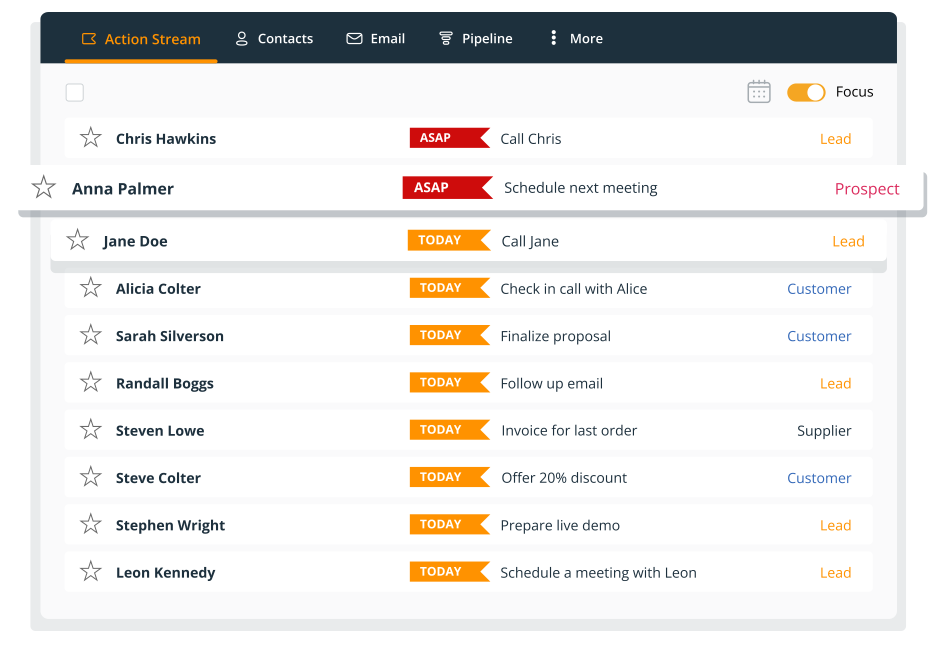
Action-based is the key point. I think it's the main difference between all the CRMs and OnePageCRM.
Building human connections
Gilles also likes how OnePageCRM organizes and stores his notes.
They help him remember important details about clients. For example, if a customer mentioned they were going on vacation, Gilles can add a quick note to the CRM and bring it up in the next conversation.
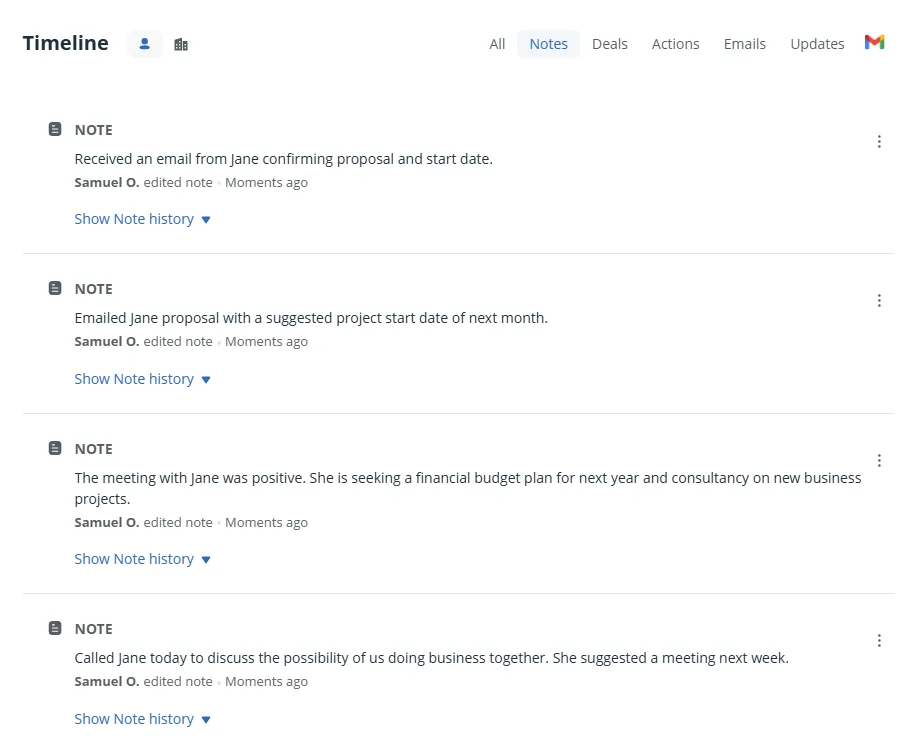
This is especially useful when you speak to people once or twice a year, before they decide to do business with you.
As Gilles puts it, “It’s not about being better at sales. It’s about being human.”
Saving time with a fast and simple system
The speed and simplicity of the system impressed him, as well. Whatever Gilles types into OnePageCRM is saved the moment he types it.
It seems like it was AI before AI. I could just type something, and it will be instantly saved.
Even adding new leads is just as quick. For instance, when Gilles finds a candidate on LinkedIn, he uses the Lead Clipper to pull their details into his CRM in less than three clicks.
Getting VIP support
Gilles also felt looked after.
Whenever he had a question, OnePageCRM's support team answered him quickly, and there was always a person on the other end.
OnePageCRM remains human. It could integrate AI into their customer service, but instead the Support team remains approachable.
Support like that is a big part of why Gilles trusts OnePageCRM enough to recommend it to the people he coaches. One of his clients had spent twenty-five years never trusting a CRM, but on Gilles's word, he gave it a try and signed up.
The price is another thing that stood out to Gilles. He says, “For the features you get, OnePageCRM’s price is very good.”
The only action-based CRM
The reason Gilles recommends it is the same thing that sold him in the first place. OnePageCRM helps him act on his thousands of candidates without missing anybody. It also saves him time. And when he needs help, the team is always there.
It's action-based. I can decide when I want to reconnect with someone. And it's very simple to use.